
"coffee plant"
51000 article(s) found

How to plant a coffee tree? The natural conditions of coffee cultivation and the skills of growing coffee.
How to grow coffee well? First of all, geographically, the golden planting belt of coffee is centered on the equator, covering the appropriate temperature from 25 north latitude to 25 south latitude. Coffee likes a warm environment, hardy but not hardy, and the most suitable planting temperature is between 16 degrees Celsius and 21 degrees Celsius. Good land environment, fertile soil. The most suitable soil for growing coffee is in the plains and mountains.

Do Burundian Panjia Jangeway Bourbon beans taste good? how to make Burundian coffee by hand?
Professional coffee knowledge exchange more coffee bean information please follow coffee workshop (Wechat official account cafe_style) Burundian Coffee Champion processing Plant Cabuye District, Cajun District, Kayanza Province, Panjia processing Plant 1810 meters Jangeway Peak Micro-batch bourbon species Burundi Kayanza Kabuye SEGEC Mpanga Nyangwe 1810m Bourbon Award record: 2014 Burundi CoE Champion (

What is the altitude above which coffee beans are planted?-Coffee bean planting conditions
Coffee beans are planted above sea level-coffee bean planting conditions the origin of coffee trees is Ethiopia in Africa. In botany, coffee trees belong to the evergreen trees of the subgenus Rubiaceae, and coffee beans, commonly known as coffee beans, are the seeds of the fruit of coffee trees, just because they are shaped like beans, so they are called coffee beans. Climate is the decisive factor in coffee cultivation.

Introduction to the processing Plant of Burundian Coffee Bean planting Environment and Flavor description
Burundi has the most diverse and successful coffee industry in the world, and has its own characteristics. Coffee in this country was introduced by Belgian colonists in 1930 and is now grown only on small farms. Unfortunately, many of these farms are on the border with war-torn Rwanda, putting pressure on coffee production. Coffee produced in Burundi.

Introduction of coffee beans from Katuji processing Plant of Ausaya Cooperative in Kenya. How to drink Kenyan AB Coffee
Professional coffee knowledge exchange more coffee bean information please follow the coffee workshop (Wechat official account cafe_style) 2018 new season Kenya Ausaya Cooperative Katuji processing Plant exquisite washing pure SL coffee producing area. Othaya Cooperative, Nyeri Country, Kenya processing plant. Gatugi Station altitude. 1864 M beans. SL2

Which countries and regions can grow coffee? Why?
Since coffee trees are tropical plants, they need to be planted in warm places. The main planting area is distributed between latitude 25 south and latitude 25 north with the equator as the center, so this area is also called the coffee belt. However, even in the coffee belt, Arabica and Robeska do not grow in exactly the same area, but grow up in an environment that is more suitable for their own growth.

Which countries and regions can grow coffee? Why?
Since coffee trees are tropical plants, they need to be planted in warm places. The main planting area is distributed between latitude 25 south and latitude 25 north with the equator as the center, so this area is also called the coffee belt. However, even in the coffee belt, Arabica and Robeska do not grow in exactly the same area, but grow up in an environment that is more suitable for their own growth.

The growth process of coffee trees planting boutique coffee
First, planting time: April 15-25 period. Second, planting location: plain, hillside, wasteland, front and back house, forest and fruit tree seedlings can be planted, but should not be planted in tall trees or other unventilated places. Third, herbal coffee does not like flood and fertilizer, conditional planting can use farm manure, during the growth period, it is best to irrigate 1-2 water during the growth period, absolutely do not allow the use of all kinds of chemical fertilizers and

Coffee Flavor characteristics and Origin Information of Saint Vincent processing Plant in Honduras, the largest coffee producer in Central America
For the exchange of professional baristas, please follow the coffee workshop (official Wechat account cafe_style) Product name: San Vincent processing Plant, Honduras Flower Mero small Farmer washing (Honduras San Vicente Juan Contreras Miraflores) production area: Santa Barbara (Santa Barbara) Pena Blanca small town processing plant: St. Vincent processing Plant (Beneficio San)
History of planting and treatment of Wamuguma in Thika Wamgumar treatment Plant, Sika District, Kenya
For the exchange of professional baristas, please follow the coffee workshop (Wechat official account cafe_style) the history of planting and processing of Kenyan coffee. The history of Kenyan coffee can be traced back to the end of the 19th world. Coffee tree species were introduced from neighboring Ethiopia in the north. After improvement of their own varieties, there are four common varieties: Bourbon and Kents.
Analysis and summary of genetic variation of coffee plants
Professional baristas exchange please pay attention to the coffee workshop (Wechat official account cafe_style) narrow leaf mutation Angustifolia leaves long and narrow, long lanceolate leaf varieties are the main parent source of coffee breeding. About 5% of C. arabica seedlings have narrow leaves. The recessive factor of two pairs of mutations of ag1 and ag2 was crossed with normal plant. The first generation was normal and the second generation was 9 positive.
Coffee bean seed price how much coffee bean planting coffee bean price seed coffee raw bean sun plus snow
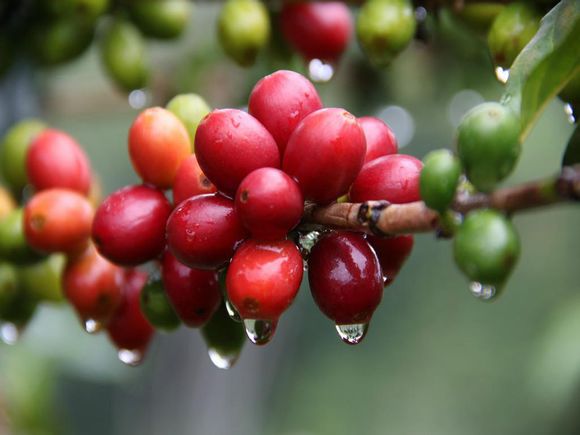
Coffee seeds cannot be grown directly with coffee fruits picked from coffee trees. Peeling coffee fruits is like planting peanuts. If you plant a peanut with a shell in the soil, it cannot sprout. You must plant peanuts. It is the same with medium coffee. If you have coffee fruit in your hand, you can first bask it in the sun and shake it until it is shaken inside.

Katim Coffee characteristics, Katim Coffee planting
Follow Kaiping (Wechat official account vdailycom) found that the beautiful cafe opened its own shop with 3846 seeds per kilogram when it was cool in the sun for two months. There were about 5000 seeds in cool sun for 5 months, the germination rate was more than 95% in two months after seed production, 85% in three months, became weak after three months, and most seeds lost their germination rate after six months. Resistance to leaf rust

Xizang's coffee, are you looking forward to it?
Xizang can grow not only highland barley potatoes. As early as two years ago, various tropical fruits such as banana, lemon, pomelo, papaya, sugarcane, mango, citrus and jackfruit were successfully grown in Motuo County, Linzhi City, Xishuangbanna. Growing coffee in Linzhi corner under the same climatic conditions may become a reality in the near future. The first trial of coffee has been completed.

Introduction to the Flavor characteristics of Kenyan Coffee from AB TOP, Guma processing Plant of Palagwe Cooperative, Kenya
Professional coffee knowledge exchange more coffee bean information please follow the coffee workshop (Wechat official account cafe_style) Kenya Kirinyaga Baragwi FCS Guama AB TOP September 2017 Coffee Review 95 the same batch of Kilinyaga District, Kenya Barag Weizuo Guma processing Plant AB TOP flavor description: bright, deep sweetness, red currant,

Yunnan small grain coffee Yunnan coffee beans
Yunnan coffee was planted on a large scale in the mid-1950s, with a planting scale of 4000 hectares at one time. By the end of 1997, the planting area of coffee in the province had reached 7800 hectares. At present, the planting area of the province accounts for 70% of the national area, and the output accounts for 83% of the whole country. Yunnan coffee has established the dominant position in China in terms of planting area and coffee bean production. The west and south of Yunnan Province

Introduction to the award-winning flavor of sun-tanned coffee in Fairview Manor, Tangmeo processing Plant, Costa Rica
Professional barista exchanges please follow the coffee workshop (Wechat official account cafe_style) Product name: Costa Rica Tangmeo processing Plant Fairview Manor Sun treatment (Costa Rica Don Mayo Finca Bella Vista Natural) Flavor description: flowers, orange fruit notes, cocoa, roasted walnut aroma, lively sweet and sour, syrup smooth 2017

Planting techniques of Coffee
First, planting time: April 15-25 period. Second, planting location: plain, hillside, wasteland, front and back house, forest and fruit tree seedlings can be planted, but should not be planted in tall trees or other unventilated places. Third, herbal coffee does not like flood and fertilizer, conditional planting can use farm manure, during the growth period, it is best to irrigate 1-2 water during the growth period, absolutely do not allow the use of all kinds of chemical fertilizers and

Costa Rican Coffee Costa Rica Microprocessing Plant.
Professional coffee knowledge exchange more coffee bean information Please follow the coffee workshop (Wechat official account cafe_style) microprocessing plant revolution before 2000, because the long-term downturn in the price of coffee beans in international trade prompted Costa Rican farmers to build their own processing plants, that is, the country's favorite "microprocessing plant revolution", Manuel Ant, operator of Herbazu.

Yunnan Coffee planting area Yunnan Coffee planting Yunnan Coffee Coffee
The term "fine coffee" was first put forward by Ms. Knudsen of the United States in Coffee and Tea magazine. At that time, Ms. Knudsen, as a coffee buyer at B.C. Ireland in San Francisco, was very dissatisfied with the neglect of the quality of raw coffee in the industry, and even some big roasters mixed a large amount of Robesda beans in the comprehensive beans, so she put forward the concept of boutique coffee.